Vittoriano Architecture: Marble, Terraces and Portico
Learn to read the Vittoriano's architectural design, including its ceremonial ascent, Botticino marble, Sommoportico and urban setting.
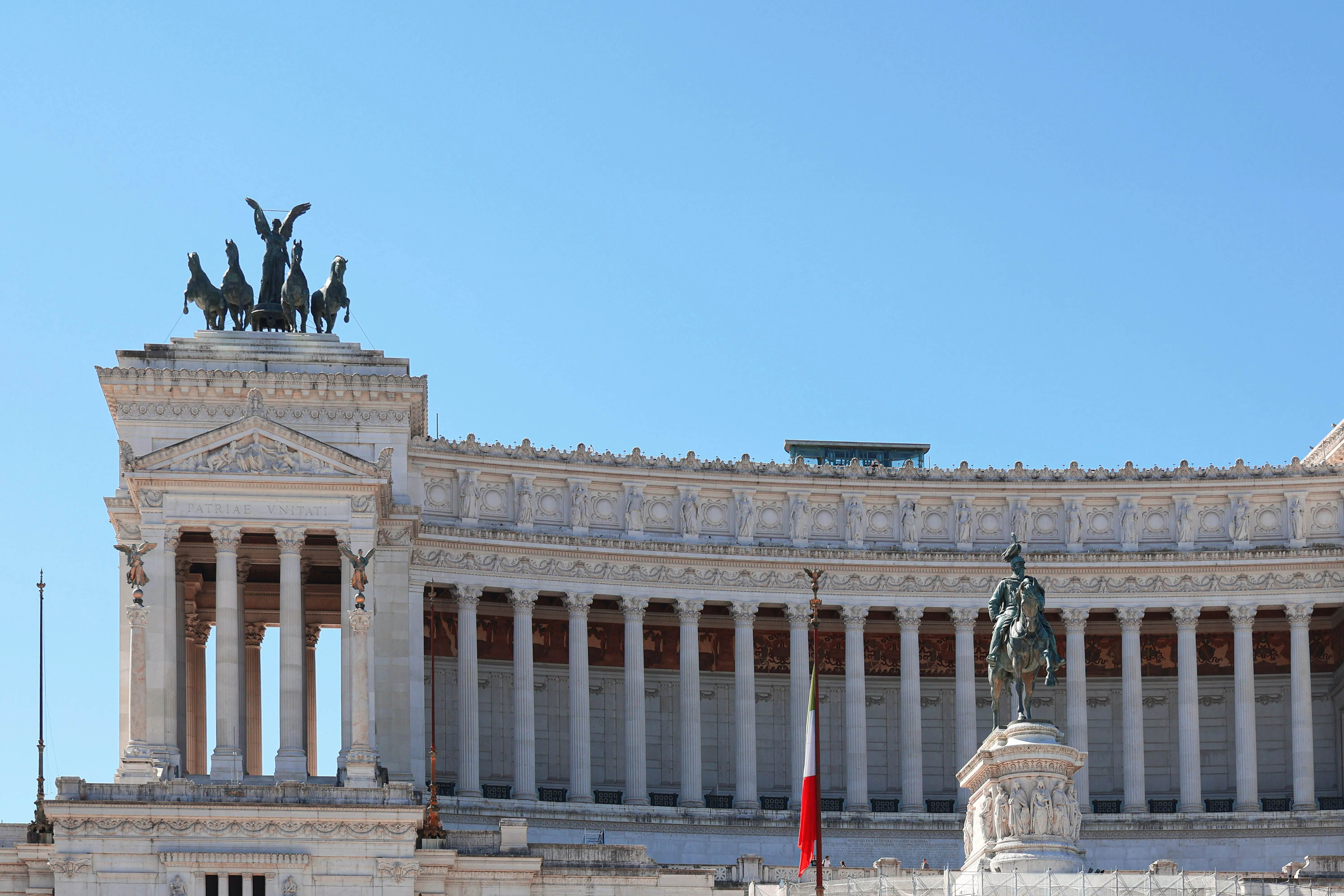
The Vittoriano is often labelled “neoclassical” and left at that. The term is useful but incomplete. Giuseppe Sacconi did not copy one ancient building; he assembled stairs, altars, porticoes, sculptural platforms and urban viewpoints into a modern civic machine. Its classical vocabulary supplies authority, while its scale and circulation belong to the age of national capitals.
A façade designed as a route
From Piazza Venezia, the monument appears like a single symmetrical front. In practice, it is a sequence of levels. Broad stairs gather visitors from the square. Lateral fountains widen the base. The central Altar of the Fatherland creates the first ceremonial focus, the equestrian statue dominates the middle terrace, and the upper portico completes the ascent.
Each level changes the visitor's relationship with Rome. At first the monument fills the view; higher up, openings reveal the Capitoline, Forum and historic centre. Sacconi turned looking back into part of the design.
The Sommoportico and propylaea
The crowning element is the Sommoportico, a long colonnade of sixteen columns, each about 15 metres high, curving gently across the upper level. The columns create a screen rather than a solid wall, allowing sky and shadow to animate the silhouette. Pavilions at the ends project forward like monumental gateways and carry the rooftop quadrigae.
The form recalls ancient sanctuaries and ceremonial approaches without reproducing any single prototype. At city scale, the colonnade gives the sprawling terraces a clear endpoint. At close range, it frames views and creates alternating compression and openness.
Why the monument is so white
The facing material is Botticino marble, quarried in northern Italy near Brescia. Its pale, compact surface produces the visual unity that Sacconi needed across an enormous composition made by many hands. Sunlight can flatten the building at noon, while morning and afternoon shadows reveal columns, reliefs and projecting sculpture.
Its colour also explains the shock the building produced in Rome. The surrounding city is dominated by warm travertine, brick, plaster and tiled roofs. The Vittoriano's brightness makes it appear separate from that palette, a deliberate declaration of newness that later weathering has only partly softened.
Sculpture as architecture
Statues are not decoration applied after the fact; they organize the building. Personifications of the Adriatic and Tyrrhenian seas occupy the fountains. Civic and moral values mark balustrades. The regions stand across the upper line. Winged victories, city allegories and the bronze king establish focal points and transitions.
This integration allowed a national story to be read spatially. Sea, city, region, virtue and ruler occupy different architectural levels, presenting Italy as a complete geography and moral community.
Scale, symmetry and deliberate excess
The Vittoriano is much larger than the buildings it displaced and many that surround it. Its scale was intentional: a young state wanted visibility in a capital already crowded with the monuments of empire and papacy. Symmetry makes that size intelligible, while repeated columns and balustrades create rhythm across long distances.
Critics have long argued that the result overwhelms the Capitoline and interrupts Rome's historic grain. Admirers point to the craftsmanship, urban drama and public vistas. Both responses begin with the same fact: the monument was designed to dominate, not blend quietly into its setting.
Proportion and repetition at the summit
The Sommoportico uses sixteen columns approximately 15 metres high. Repetition gives the upper level a steady rhythm visible from across Piazza Venezia, while the slight curve prevents it from reading as a flat temple front. Sixteen historical-region statues continue that rhythm above, transforming the architectural crown into a geographic statement.
At each end, a projecting propylon provides enough visual mass to stop the colonnade. The bronze quadrigae complete those terminals vertically. Carlo Fontana's Unity and Paolo Bartolini's Freedom are paired by concept and silhouette; because official descriptions conflict over compass-side assignment, artist and ideal are the safer identifiers.
Architecture shaped by the hill
The frontal symmetry can hide how heavily the building depends on topography. Sacconi inserted large foundations and internal volumes into the Capitoline slope, then used terraces to convert a difficult change of level into ceremonial ascent. Side and rear views expose this negotiation more clearly than the façade.
The neighbouring Basilica of Santa Maria in Aracoeli is especially instructive. Its older mass and separate staircase meet the Vittoriano at an awkward, historically layered edge. This is not a flaw visible from the ideal frontal viewpoint; it is evidence that the new national monument was imposed within an existing city.
Light, shadow and the legibility of marble
Botticino marble can look almost flat in strong midday sun. Oblique light restores the depth of capitals, reliefs, cornices and statues. Sacconi's architecture relies on projecting planes and repeated shadows to keep an enormous pale surface readable. Bronze provides the strongest tonal contrast at the king, victories and quadrigae.
Weathering changes the effect. Water paths and pollution can darken recesses, while conservation cleaning risks making restored areas appear temporarily brighter than their surroundings. The monument visitors see is therefore shaped by maintenance as well as original design.
The 2007 lifts as a contemporary intervention
The panoramic glass elevators opened on 2 June 2007. They do not imitate columns or marble, and that difference is architecturally important. A transparent modern structure announces its date, limits confusion between original and added fabric, and makes the summit available to visitors who could not reach it through stairs alone.
Their presence also changes the building's programme. The upper architecture is no longer only a distant civic crown; it is a close-viewed public destination. Good interpretation should therefore connect the 360-degree panorama with the designed sequence below rather than treating the lifts as an attraction detached from Sacconi's work.
Architecture as a frame for the capital
At ground level, the Vittoriano is the object and Rome is the setting. Each terrace reverses that relationship until, at the summit, the monument becomes a frame around the city. The Forum, Capitoline, historic centre and distant domes occupy views organized by Sacconi's ascent.
This changing visual hierarchy is an architectural effect, not merely a rooftop bonus. It connects national symbolism to possession of a capital view: the monument first commands Rome's skyline and then offers Rome back to the visitor as a panorama. Understanding that exchange explains why stairs, terraces and openings are as important as columns and statues.
Compare front, side and summit
The front explains order, the side explains construction and the summit explains urban purpose. A complete architecture visit needs all three. If weather closes the roof, the side relationship with Aracoeli and the upper colonnade still reveal more than a single central photograph. Architecture here is movement through changing viewpoints, not a façade to be consumed from one mark on the pavement.
Interiors behind the ceremonial front
The exterior can make the Vittoriano look solid, yet internal rooms and passages occupy its great base. The Central Museum of the Risorgimento uses galleries within the monument, turning symbolic architecture into a container for documents and objects. Circulation between outside and inside is therefore part of the experience rather than an accidental add-on.
The modern glass lifts at the rear, opened on 2 June 2007, are intentionally distinct from the marble. They provide access to the summit while revealing their own time and technology. This contrast is more honest than imitating Sacconi's historical forms.
A close-looking itinerary
Stand across Piazza Venezia to understand the full silhouette. At the fountains, look at how sculpture anchors each side. From the altar level, compare the relief surfaces with the smooth stair planes. Walk laterally around the equestrian terrace to break the frontal symmetry. Finally, rise to the Sommoportico and summit, where the building becomes a frame for Rome rather than an object viewed from outside.
The reward is a more precise judgment. Whether you find the Vittoriano magnificent, overbearing or both, its architecture becomes legible as a carefully staged answer to the political and urban problems of modern Italy.
Về tác giả

Rome Visitor Guide
Hướng dẫn độc lập này được tổng hợp từ thông tin của VIVE, Bộ Văn hóa Ý và các bảo tàng để giúp du khách phân biệt lối vào miễn phí với trải nghiệm có vé.
Tags
Comments (0)
Loading comments...