Vittoriano Regional Statues and Their Meaning
Understand the regional allegories crowning the Vittoriano and how sculpture joined Italy's distinct local identities into one national image.
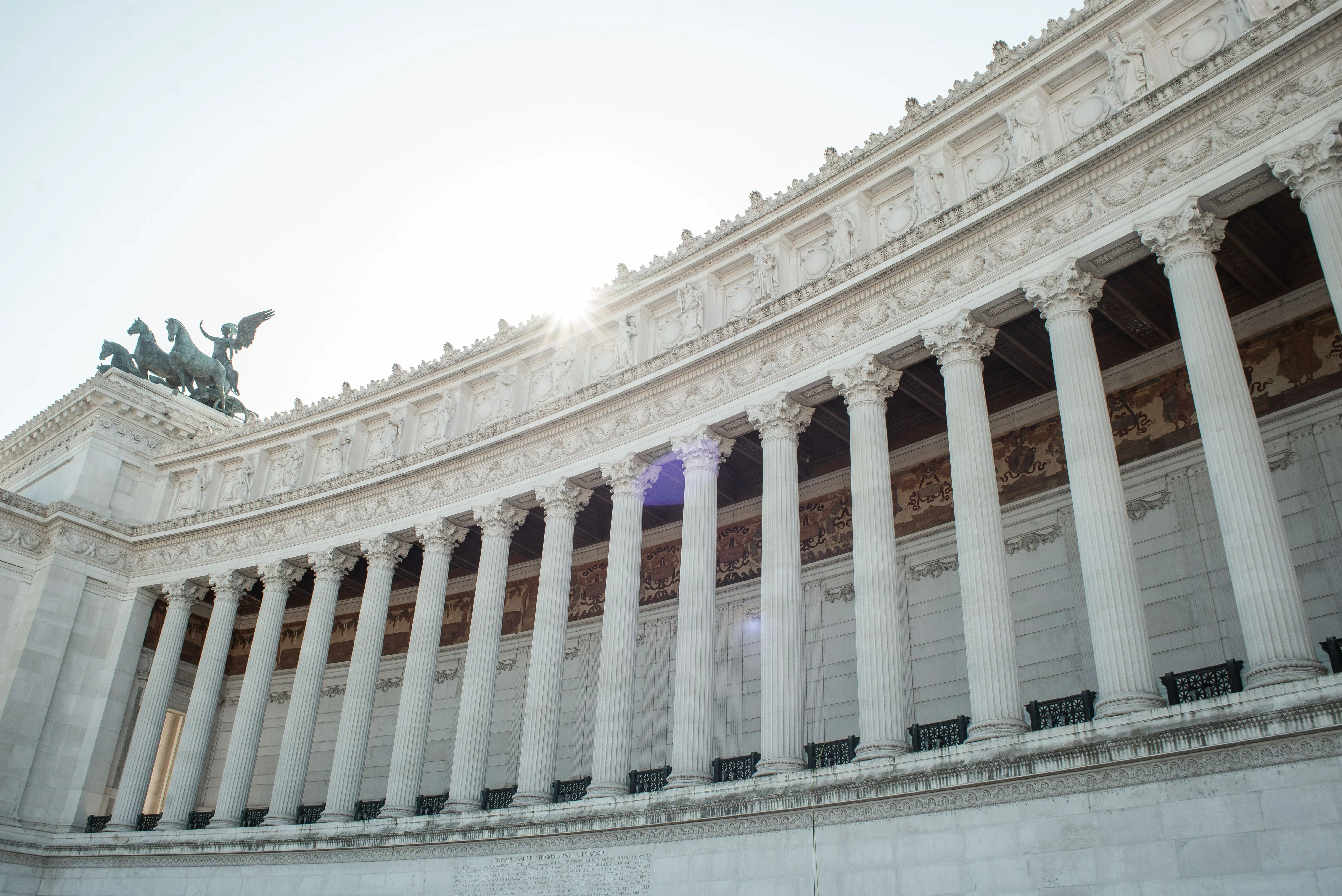
Look above the Vittoriano's great colonnade and the skyline is not empty. Sixteen female personifications represent the historical regions recognized when the artistic programme was formed. They are easy to read as generic classical figures from the square, but together they address one of unification's hardest questions: how could a nation of powerful local identities picture itself as one?
Why regions mattered
Political unification in the nineteenth century did not dissolve older states, dialects, civic loyalties or cultural differences. The new kingdom needed symbols broad enough to include the peninsula without making every place look identical. Allegory offered a familiar solution. A sculpted body could embody a territory through costume, attributes and references to local history or economy.
At the Vittoriano, the regional figures occupy the upper architectural order above sixteen columns roughly 15 metres high. Their placement turns the Sommoportico into more than a classical colonnade: it becomes a national assembly in stone.
A historical map, not today's checklist
Visitors should resist matching the sequence mechanically to the current twenty administrative regions. The programme reflects Italy's political geography at the beginning of the twentieth century. Borders, regional definitions and the status of territories changed after the First World War and in the republican period.
That difference is useful. Monumental sculpture freezes one historical way of organizing the nation. It tells us what the commissioners chose to recognize then, not an eternal or neutral map.
Local artists and national art
The regional statues were created as individual works within a coordinated programme, with artists connected to the territories they represented. This method turned production itself into a statement of unity: different sculptural voices contributed to one architectural crown.
The result is not perfectly uniform. Variations in pose, drapery and attribute remain visible, especially from the upper levels. Sacconi's repeated columns and pale material provide the framework that holds those differences together.
Why there are sixteen figures
The sequence comprises sixteen historical-region personifications, matching a way of describing Italy used when the programme was developed. Present-day Italy has twenty administrative regions, so a modern checklist will not align. Borders changed after the First World War, and later republican administration formalized a different regional map.
This is not an error to be corrected by forcing current names onto old statues. It is precisely what makes the group historical evidence. The sequence records which territorial identities the commissioners wanted to place above the national monument at the beginning of the twentieth century.
A sculptural federation
The regional commissions involved different artists, many connected with the places represented. In principle, local artistic voices contributed to a single national ensemble. Sacconi's architecture supplied the uniform order: repeated columns, consistent scale and Botticino marble make varied figures read as one crown.
Look for individuality within those constraints. Some statues depend on a strong silhouette; others gather attributes close to the body. Drapery can be severe or animated. The differences show that “national style” was assembled from multiple workshops rather than produced by one hand.
Compare regions with the fourteen cities
The upper regional figures are often confused with the allegories around Victor Emmanuel II's pedestal. Giuseppe Maccagnani's base has fourteen historic-city figures, a separate group with a different place in the programme. Cities surround the king; regions crown the architecture; the Adriatic and Tyrrhenian fountains define maritime edges; Roma occupies the central altar.
Together these layers build a geography without using a literal map. Their vertical order also expresses hierarchy: local and territorial identities become components of a national composition centred on Rome and royal unification.
What allegory leaves out
An ideal female figure cannot show economic inequality, linguistic diversity, conflict over annexation or the daily difficulty of integrating the new kingdom. Nor do the statues represent every community or identity in a modern sense. Allegory turns disputed history into composed bodies.
The appropriate response is neither to dismiss the figures nor accept them as neutral. Read them beside museum evidence. Flags, letters and personal objects in the Risorgimento Museum reveal political choices and lived experience that the serene regional assembly deliberately suppresses.
The sequence can also be compared with modern regional identity without claiming direct continuity. Today's regions are administrative, political and cultural realities shaped after the statues were conceived. The Vittoriano figures instead show an early national vocabulary selecting idealized histories and attributes. The gap between those systems is the subject: it demonstrates that geographic identity is constructed and revised, not simply carved once for all time.
How allegory communicates
Allegorical sculpture works through clues rather than portrait likeness. A crown, agricultural product, tool, animal, historical reference or style of dress can point toward a place. Some references would have been more immediately legible to an early twentieth-century Italian audience than to an international visitor today.
This partial opacity is not a reason to ignore the figures. Instead, compare how each balances an idealized classical body with specific local signs. The tension mirrors the wider monument's attempt to make modern Italy look both ancient and newly unified.
Regions, cities and seas
The regional sequence belongs to a broader geography spread across the Vittoriano. Major city personifications surround the base of Victor Emmanuel II's equestrian statue. The Adriatic and Tyrrhenian seas appear as fountains at the lower sides. Rome occupies the central altar as a commanding personification.
Read together, these elements create a symbolic map: seas define edges, cities provide civic history, regions supply territorial variety and Rome forms the national centre. The king sits within that map rather than standing alone.
The politics of the arrangement
Any national allegory simplifies. It can make unification appear harmonious and inevitable, masking military conflict, political disagreement and uneven social conditions. The statues present a composed family of regions, whereas real integration involved negotiation and resistance.
That does not make the art false or irrelevant. It identifies the statues as political images—evidence of the state's desired self-portrait. The nearby Risorgimento Museum helps visitors compare that polished ideal with documents, personal objects and competing political projects.
Best way to see the statues
From Piazza Venezia, notice the figures as a continuous rhythm above the columns. As you climb, use oblique viewpoints from the terraces and sides, where silhouettes separate more clearly. The paid Sommoportico route, when open, offers the closest architectural context. A camera zoom can assist, but avoid making visual claims from distant details you cannot verify.
Morning or late-afternoon side light usually reveals modelling better than high noon. The summit terrace also changes their scale: figures that looked small from below are revealed as monumental works positioned against the city.
A lesson in plural identity
The most interesting message is not that every region became the same. The monument needs many figures precisely because Italy remained plural. Unity is expressed as an arrangement of differences within one structure.
For contemporary visitors, the sequence can prompt questions as much as answers. Which identities were included? How were they idealized? How has the map changed? By asking those questions, a decorative skyline becomes a historical document about the difficult visual construction of a nation.
Tentang penulis

Rome Visitor Guide
Panduan independen ini disusun berdasarkan informasi VIVE, Kementerian Kebudayaan Italia, dan museum untuk membantu pengunjung membedakan akses gratis dari pengalaman bertiket.
Tags
Comments (0)
Loading comments...