Vittoriano Accessibility and Family Visit Guide
Use verified information on the Vittoriano's step-free entrance, lifts, wheelchairs, tactile routes, family activities, toilets and pacing.
The Vittoriano looks like a mountain of stairs, but the monumental front is not the only way through it. VIVE provides a step-free route, courtesy wheelchairs and accessible programmes. Families also benefit from lifts, toilets and educational activities, although exposed terraces and one-way circulation still require planning.
The step-free entrance
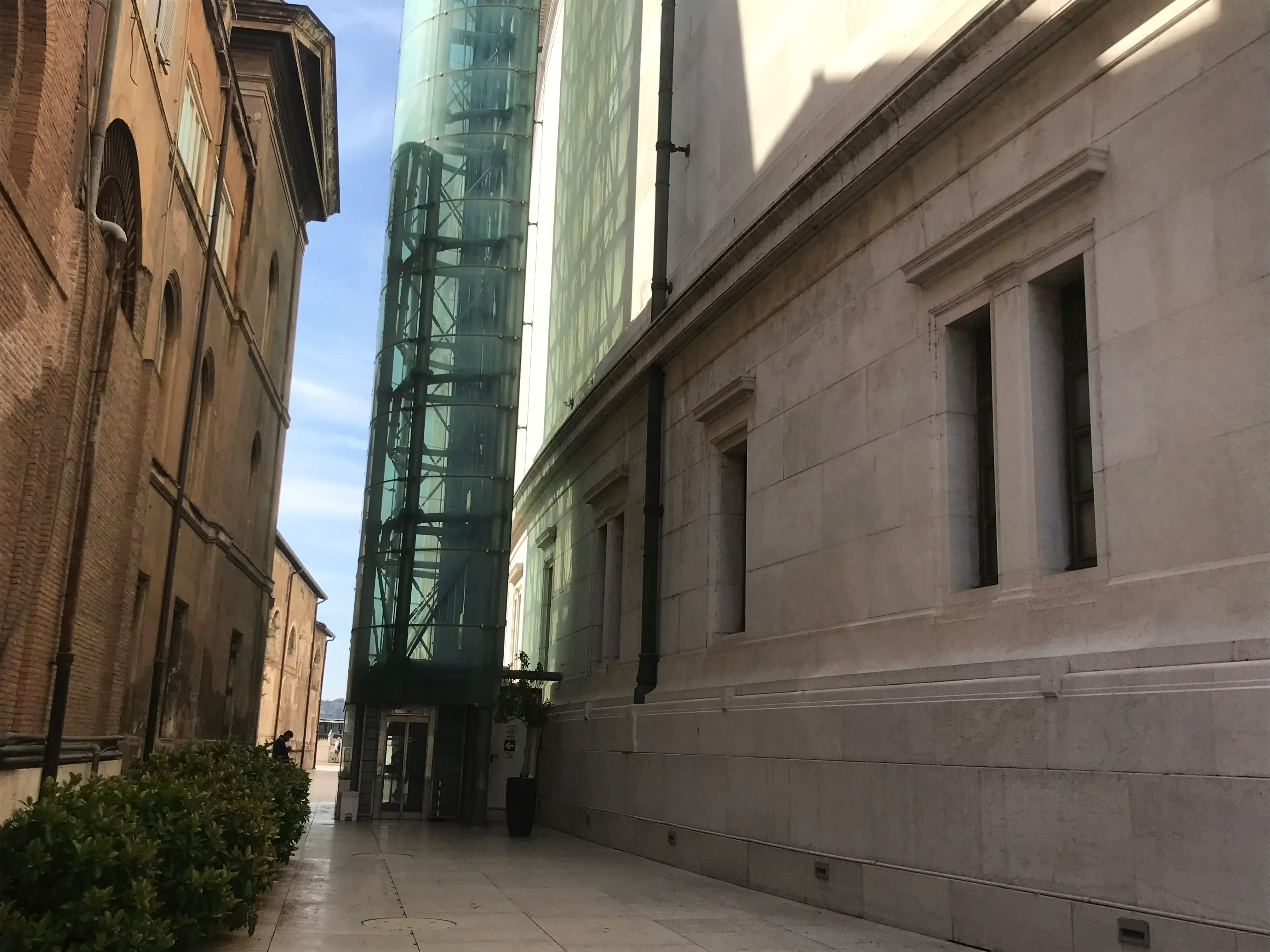
The accessible Vittoriano entrance is on the Aracoeli side. Official VIVE information states that it has a wheelchair platform lift and an internal lift reaching Terrazza Italia. From that level, two panoramic glass lifts continue to the summit.
Do not begin at the central Piazza Venezia stairs and expect to find a ramp alongside every flight. Ask staff for the Aracoeli-side route from the start. Circulation can be modified during events, so visitors with a specific need should contact VIVE before travelling and confirm the route on arrival.
Wheelchairs and accessible coverage
Courtesy wheelchairs are available at the Aracoeli-side entrance and at Palazzo Venezia's Via del Plebiscito entrance, subject to availability. VIVE states that 90 percent of public spaces and reception facilities are accessible by lift. That figure also implies that not every historic or monumental area is identical in access.
Visitors with disabilities currently receive free admission. A qualifying accompanying family member or care worker is also entitled to free entry under the official policy. Bring documentation appropriate to the concession and check current Ministry of Culture rules before the visit.
Blind, visually impaired, deaf and hearing-impaired visitors
VIVE offers tactile itineraries developed with the Italian Union of the Blind and Partially Sighted. It also organizes tours in LIS, Italian Sign Language. These are programmed activities rather than services that should be assumed at every hour, so consult the Education schedule and reserve where required.
For a personalized question, VIVE invites visitors to contact the institute. Giving advance notice is especially useful for groups, guided tactile experiences or a visit during a major ceremony.
Strollers and young children
The accessible lifts can make a stroller visit practical, but the route is one-way and may involve waiting at transitions. A compact stroller is easier in galleries and lifts than a large model. Keep children close on broad terraces, where steps, balustrades and crowds demand attention.
The front stairway is long and exposed. In hot weather, use the side entrance or visit early rather than treating the climb as an endurance activity. The rooftop can be windy even when the square feels sheltered.
Family activities
VIVE currently organizes activities for families with children aged 5–12 on Saturdays, Sundays and public holidays. The official page lists a fee of €5 per participant in addition to any applicable admission ticket. Museum educators lead the itineraries, and advance contact is recommended.
Programme, language, age range and dates can change. Verify the current Education listing rather than promising children a specific workshop based on general information.
Building a child-friendly visit
Give the monument a simple visual theme. Younger visitors can look for horses, wings, lions, flames and the two giant chariots. Older children may compare the named king with the Unknown Soldier or use the rooftop to identify the Colosseum, Forum and St Peter's.
Keep the museum selective. Choose a flag, letter and personal object rather than reading every case. A 60–90 minute visit combining exterior and roof is often more successful for a young family than a complete museum circuit, though interests vary.
Facilities and rest
VIVE lists toilets and baby-changing facilities along with a cafeteria-restaurant. Seating is available only in designated places; staff can direct visitors to the nearest option. Food and drinks must be consumed in the cafeteria rather than galleries or memorial spaces.
The cafeteria on the panoramic level offers a planned rest point, but opening and capacity should be checked. Carry essential water for children while respecting rules about where it can be consumed.
Bags larger than 40 × 35 × 15 centimetres are not admitted under current rules. Personal photography must avoid flash, tripods, monopods and selfie sticks. Verify these restrictions on VIVE's main Visit page because security and visitor policies can change.
Prepare children for the memorial before arrival
Explain that the guarded tomb belongs to an unidentified soldier and represents many people who died in the First World War. A short explanation makes the flames and guards understandable without overwhelming younger visitors. Ask children to observe quietly and save energetic movement for a later terrace.
The contrast between named and unnamed figures can support older children's learning. Victor Emmanuel II is represented at enormous scale and identified in detail; the soldier below has no known name. That difference opens a conversation about how monuments remember rulers, citizens and collective loss.
Choose the right level of help
“Accessible” does not mean identical for every visitor. Someone using a wheelchair, a blind visitor joining a tactile itinerary, a deaf visitor seeking an LIS tour and a family with a stroller need different information. VIVE offers specific programmes, but schedules and reservation requirements vary.
Contact the institute before the visit for lift dimensions, a guided programme or a temporary route concern. On site, security and reception staff can direct visitors to courtesy wheelchairs, designated seating and the correct lift sequence. This is more reliable than following the crowd up the central steps.
Sensory and ceremonial considerations
Piazza Venezia is noisy and traffic-heavy, while security, crowds and the changing of the guard can produce concentrated activity. The monument itself includes exposed bright surfaces and echoing interiors. Quieter weekday mornings may be easier for visitors sensitive to noise or crowding.
The Tomb of the Unknown Soldier requires respectful behaviour. Explain the guards and flame before approaching so children understand why this part of the visit differs from an ordinary terrace.
Confirm before leaving
Hours, ticket concessions, lift availability and programmes may change. Check the official VIVE visit and Education pages, and write to the institute for needs not answered there. Good preparation does not eliminate every barrier, but it turns an apparently stair-dominated landmark into a much more manageable visit.
Om forfatteren

Rome Visitor Guide
Denne uafhængige guide bygger på oplysninger fra VIVE, det italienske kulturministerium og museerne og hjælper besøgende med at skelne gratis adgang fra oplevelser med billet.
Tags
Comments (0)
Loading comments...